


Huilerie Leblanc
A millstone over 200 years old. A family, in its fourth generation, since 1878. And oils sought after by haute cuisine.

Travel report by Anaïs Causse and Thomas Vetter
Summer 2011: We drive into the mountains of the Massif Central to visit the family from whom we source our oils, vinegars, and mustards.
Hail on the mountain pass
Around noon, we were driving leisurely into the hills – and with every kilometer, the weather worsened. On a mountain pass, we drove straight into a huge, dark gray cloud that hung right over the road. Then came torrential rain, wind, and hail. You could barely see your hand in front of your face. And as suddenly as the storm had begun, it was over: Just as we arrived in Iguérande, the sun emerged from behind the clouds.
We were greeted by one of the two Leblanc brothers, who run the mill in the fourth generation – friendly, unruffled, as if visitors from Berlin came every day.
“The millstone is over 200 years old.”
Monsieur Leblanc placed great importance on this.
How the oil is made
The oil is still made exactly as it was in the founding year of 1878. To get the milling process started, a motor on the wall is switched on, which drives a complex arrangement of gigantic gears and fan belts – and ultimately sets the large millstone in motion.
Milling. The oil fruit – walnuts, hazelnuts, pine nuts, pistachios, grape seeds – is slowly ground into a paste under the granite stone for about 20 minutes.
Roasting. The paste goes into a huge cast-iron pan and is heated over an open fire at a low temperature for around 15 minutes. This releases the aromas.
Pressing. Then the mass is gently cold-pressed in large presses.
Resting. The oil is initially cloudy and stored in large canisters for about a month until the clouding particles have settled. Only then is it bottled.
So if a cloudy deposit ever forms in a bottle, it is not a bad thing, but a residue of fruit pulp that had not yet settled before bottling. Only olive oil does not undergo roasting – otherwise, the process is the same.
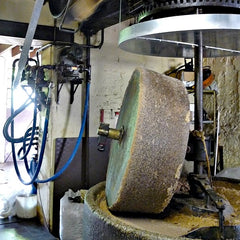
Gears, fan belts, granite: the mill in Iguérande.
Only the best fruit – no matter what it costs
The pistachios come from Iran, the walnuts from Périgord, the hazelnuts from Piedmont. The Leblancs search the world for the best quality; cost plays a minor role. Two examples that illustrate their attitude well: They could source cheaper pistachios from California – but they order from Iran because they believe theirs are significantly better. And because no good pine nuts had been available for four months, no pine nut oil was produced for four months.
When we asked whether the food safety authorities had any problems with this “old-fashioned” production, Monsieur Leblanc said: They are inspected, certainly, and fairly frequently, but they are left alone – oil is not a food that can go bad during production. And ultimately, it is simple: If they are no longer allowed to work the way they do, they will stop.
The vinegars and mustards are produced exclusively by the Leblancs in two selected businesses in the region, with the same care. After a small oil tasting, we got into the car with slightly oily chins and continued into the mountains.

